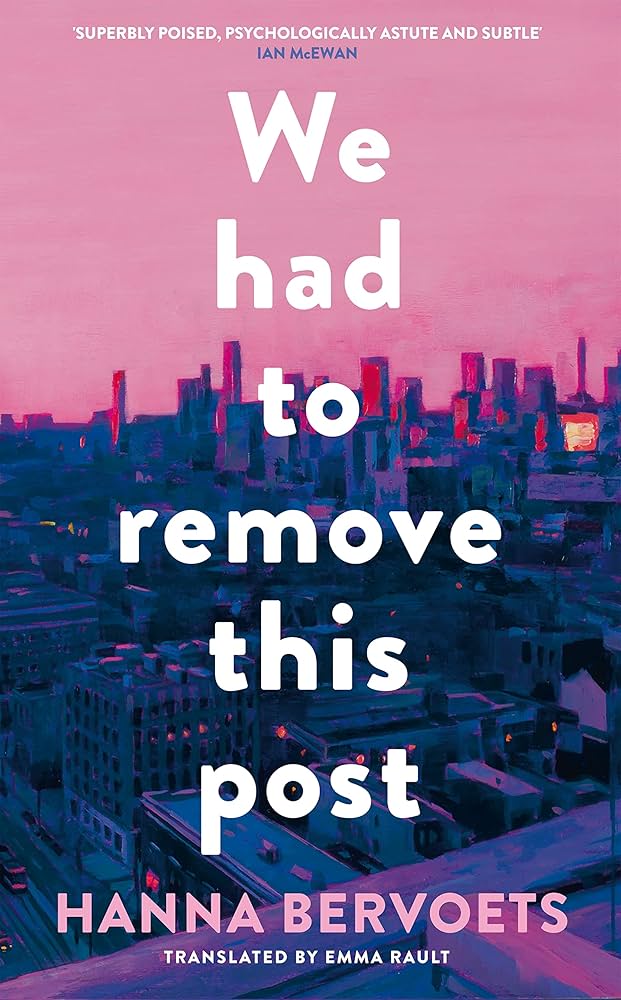
Full disclosure: I picked up the book after it’s been recommended by a book club friend. Due to an unfortunate confluence of a misleading book title, miscomprehension brought on by skimming that recommendation too fast, and my steadfast refusal to expose myself to potential spoilers, I thought, for the longest time, I was reading nonfiction — a badly-written account about being a moderator of the dark side of social media.
As it turns out, We Had to Remove This Post isn’t a nonfiction. It’s a psychological thriller and cautionary tale.
Moving on.
Twenty-six-years-old Kayleigh was down on her luck. Her ex-girlfriend had just broken up with her and she had accrued debt from the relationship. To pay off her debt, she applied for a job at a content moderation company that subcontracted the work from an unnamed social media platform. Kayleigh and her co-workers were trained to sift through content flagged by users and decide their individual fate according to moderation rules. While trudging through Internet sludge, she found love with a female colleague.
If you’re like me and have no idea how contents are removed on social media, this novel provides a good overview. Kayleigh took us through her training process, how they evaluated flagged content, and how they themselves were evaluated.
We learned that the set of moderation rules meant to promote fairness, freedom of expression, and quantification ended up taking away the humanity of the moderators. Moderators were taught to judge a content not by human morality or common decency but by whether they checked the boxes qualifying them for removal. They were expected to moderate like unfeeling machines and were treated like unfeeling machines. Mental health problems were rampant among the moderators, and quite a few of them fell prey to conspiracy theories.
It was against the backdrop of this horrible job that Kayleigh navigated her relationship with Sigrid, a colleague-turned-girlfriend.
Their relationship took up most of the novel.
You know how, when reading a story, you tend to be more sympathetic toward the narrator? You commiserate with them, make up excuses for them, and conclude, along with them, that it’s the other person who’s at fault. Except people usually leave out details that make them look bad. So you’re only getting a redacted version of the true story and commiserating with a phantom.
We call those storytellers unreliable narrators.
Kayleigh was an unreliable narrator. It took me a while to figure that out.
Originally taking her story at face value, I assumed she and Sigrid broke up simply because Sigrid had subscribed to conspiracy theories and Kayleigh didn’t. Until the last few dozen pages revealed the truth.
Sigrid had been avoiding Kayleigh, so Kayleigh accosted her outside work. Then, for the first time, we’re seeing their relationship from Sigrid’s point of view. From Sigrid’s perspective, Kayleigh was stalker-ish and overbearing. She didn’t respect boundaries, and there’s something in that video of the two of them having sex that’s alarming and simply unforgivable. That’s when we get a completely different, very enlightening perspective of that sexual encounter.
Let’s recap Kayleigh’s perspective of the encounter first.
Sigrid had returned from her vacation with her ex-boyfriend. Kayleigh and Sigrid went back to their routine of fooling around in the supply closet. On one occasion, Sigrid suggested they film themselves. Kayleigh didn’t recount anything about the sex itself, except to say that the camera really got her going. After that incident, Kayleigh and Sigrid barely sex had anymore.
Sigrid’s video painted a clear picture of what happened during the encounter: Kayleigh asphyxiated Sigrid during sex, and it was heavily implied that Sigrid didn’t consent to the asphyxiation.
What Kayleigh had recounted as normal, albeit exciting, sex was in fact sexual assault to her partner. What does that say about the mental state of our narrator?
Lack of empathy?
Reduced impulse control?
Dissociation from reality?
Sociopathy.
That’s when everything began to come together. All the details that appeared to me as too crass or just outright strange began to make sense. Kayleigh’s sexual aggression, her peculiar candidness in recounting her personal life, especially her sexual habits, to Mr. Stitic, her stalker-like behavior, her ploy to win back Sigrid, breaking and entering. They were all subtle signs of Kayleigh’s mental descent. Her job had gradually and perniciously turned her into a sociopath with no regards for human decency or even the law. Worst of all, Kayleigh didn’t know it, just like Sigrid didn’t know she’s fallen prey to conspiracy theories. Her moment of clarity came only when she’s caught doing something truly outrageous.
Kayleigh had been falling. And she’s just starting to realize it.