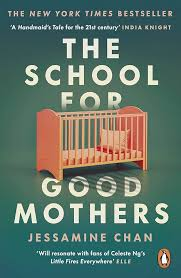
If The Handmaid’s Tale had a secular prequel…
Women who lost custody of their children to an overreaching government with draconian standards on ‘child protection,’ who are then sent to a school where they’re cut off from the outside world and learned how to be ‘good’…
Sounds familiar? Yeah, like a ease-you-into-it version of what happened before the events of The Handmaid’s Tale. There’s even a phrase the women at the school are supposed to say regularly to remind themselves of their failings and which doubles as… well, a brainwashing tool.
“I am a bad mother. But I have learned to be good.”
(Need I say more?)
In this dystopia, we follow Frida as she experienced the fallouts of her ‘very bad day’ — a day when, overwhelmed by her life and duties as a single mother of an eighteen-months-old, Frida went out for coffee and subsequently left her toddler, Harriet, alone in her house for two hours.
Her co-parents, aka her ex-husband and his new young girlfriend, lived nearby. Why didn’t she ask them to take Harriet when she found herself overwhelmed? Well, that’s a question the novel didn’t explore. But I think she didn’t want to come across as a failure to her romantic rival — the young girlfriend.
CPS intervened and removed Harriet from Frida’s care. Harriet’s father and his girlfriend are given full custody for the time being while Frida’s subjected to an excruciating process of vetting. In place of home inspection, there’s 24/7 monitoring of Frida’s home life through cameras installed in almost every room of her home. There were timed, supervised visits where Frida’s interactions with Harriet were recorded, analyzed, and then overanalyzed.
By the end of the vetting, the court offered Frida the choice between going through a year-long training program and losing custody of her child completely.
Frida opted for the program designed to train the ideal mother…

I started the book with high hopes. In many ways, it delivered. The plot’s fairly creative and reminds me a lot of The Handmaid’s Tale. But I also have some issues.
The School for Good Mothers is supposed to explore the unrealistic standards on motherhood and parenting in today’s society.
For me, some parts of the message barely came through while other parts were too on the nose.
Let’s start with the training school.
It’s meant to be a caricature of how parents today are expected to be physically and mentally healthy, perfectly in control of their emotions, and knowledgeable. Parents are also expected to be experts in developmental psychology, offering exactly what a child need at each stage of their life to develop into a well-adjusted, rounded human being.
Perhaps it’s because I’m not a parent, I cannot relate. The pressure to be a good parent exists, but I feel it’s more personal than societal. It stems from the desire to see one’s children healthy and happy and successful, from the desire to maintain good relationships with them, not from peer pressure or government directive.
That’s why the training school feels more like another gross encroachment on human rights than an exaggerated but still relatable fact of life.
Then there are the characters.
Our protagonist Frida began as a woman overwhelmed by the problems in her life and making bad choices and ended as a woman overwhelmed by the problems in her life and making bad choices. She was, and remained, emotionally dependent on her ex-husband. The sole character development occurred during Frida’s year-long training. Under the instructors’ critical eyes and ubiquitous evaluations, she and her doll-daughter in the training school formed a mutually caring and beautiful bond. But it never lost the taint of being performative and a means to an end, thus, never went anywhere. Overall, Frida feels less like a character and more like a plot device used to inform readers how very unfair society is.
Little attention was paid to the development of other characters. The side characters came across as either flat in a slightly cruel manner, or just flat. Frida’s fellow mothers at the school suffered especially from the later. To be honest, I remember little about them individually.
–
There’s something about the tone of the book that, once I started reading, provoked a feeling of immense anxiety and infuriation. Almost every character spoke or acted in a way that made me wish I could reach into the book and smack them in the face. Since we’re supposed to relate with Frida, I assume Chan intentionally provoked this reaction. But it turned stale as the book progressed.
We get the point: The government officials lacked basic empathy and didn’t actually care about children welfare. The instructors at the parenting school were trained in psychology by criminals. Women were internalized misogynists and men were magnanimously misogynistic.
But stereotypical portrayal of characters becomes reductive as the story went on. There’s no depth to Ms. Torres, the antagonistic social worker or any of the instructors at school. That one subplot of preferential treatment for men has an archetypal development: The man messed up worse, yet he was let off easy.
Similarly, there’s no background for the dystopian society. What prompted the overzealous CPS operations? Why was the government bent on prosecuting parents with petty offences? It’s one thing to remove a mistreated child from their parent(s) custody, and quite another to round up every unfit parents, process them, and run an elaborate (not to mention costly) program to ‘rehabilitate’ them.
All in all, I think this novel is meant to be a caricature of societal expectations in parents. It could really resonate if you have all the right experience. Otherwise the characters would come off as flat with its messages more ‘told’ than ‘shown.’