Opioid.
It’s a class of drugs derived from a natural substance found in the poppy plant. This natural substance has long been known for its pain relief property, as well as its highly addictiveness.
The United States of America has an opioid epidemic.
It started in the late 90s, when an increasing number of Americans started abusing morphine and oxycodone. By the 2010s, many had graduated to heroine, then fentanyl, then cocaine. With each ‘upgrade,’ the opioid becomes more potent and more deadly. Since the start of the epidemic, more than a million people have died from opioid overdose. At its height, opioid overdose killed more than 70,000 Americans a year, surpassing motor vehicle fatalities that same year by a shocking 75%.
And that’s just your standard overdose death. If we include Americans who have died from drug-related accidents (car crash while the driver’s high etc.), the number of opioid-related death would only be higher. Then there are the Americans around the country still struggling with opioid addiction.
Economical lost from the epidemic is astronomical.
How did America fall prey to a drug known for its addictive properties since the beginning of time?
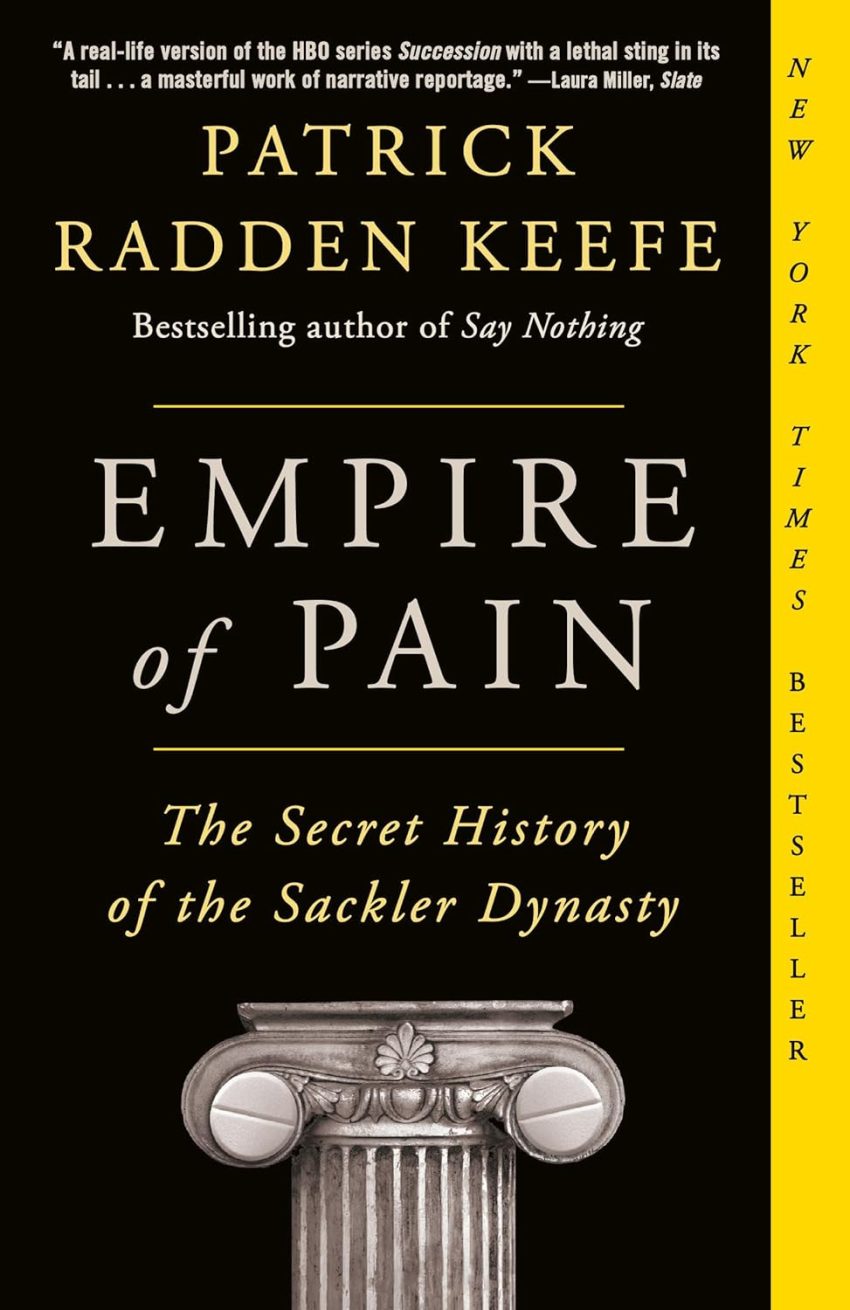
Empire of Pain takes a deep dive into the family whose pharmaceutical business single-handedly started the opioid crisis that has plagued America for the last three decades — the Sackler family.
Beginning with the twentieth century, the book spans more than a hundred years and three generations, chronicling the rise of the Sackler family, their production and aggressive marketing of the pain relief (analgesic) drug OxyContin, their reputation laundering, and, recently, their reckoning. The author was comprehensive in his research with great referencing etiquette. While I find some sections rather ‘filler-ish’ (the one about Madeleine Sackler’s documentary, for example), they didn’t detract from my enjoyment of the book.
This book is a must-read for those interested in the opioid crisis of the United States. And I rate it a ten out of ten.
[Spoilers ahead]
The Beginning

Every story has a beginning, and Keefe chose to begin his story with Arthur Sackler, a man who died a decade before the start of the opioid crisis. More than a fifth of the book was dedicated to the man who led his family into medicine and pharmaceutic. The Sacklers’ success, Keefe argued, began with Arthur. He laid the groundwork for the Sacklers’ Empire of Pain.
Though he studied as a medical doctor, Arthur Sackler’s first pot of gold came not from treating patients but from selling to them. He pioneered the practice of selling drugs directly to physicians and, even, the patients. His medical advertising agency helped newly-discovered drugs become blockbusters. Among the drugs he successfully marketed was the infamous Valium, a tranquilizer with drug dependence tendencies.
By the time of his death in 1987, Arthur and his family had a finger in drug development, drug marketing, and medical publication — the entire pipeline you might say. They were powerful in the for-profit, corporate side of medicine and contributed to the non-profit. This extensive network of family business paved the path for the blockbuster success of a new drug the family would develop almost a decade later — an opioid named OxyContin.
A Case of Common Greed
What sells better than a product that could almost guarantee reordering?
I don’t think the Sacklers started out with the express intent of developing an addictive drug and making addicts of its users. But when OxyContin, a slow-release pain relief medication, turned out to be faster releasing and more addictive than previously predicted, the Sacklers certainly had no qualms downplaying its dangers for the revenue it brought them. In fact, they convinced Americans of the opposite. Through marketing strategies pioneered by Arthur, the Sacklers successfully removed the old stigma associated with opioids.
“It’s scientifically proven to be less addictive.”
“It’s the answer to chronic pain, a condition the medical world has neglected for far too long.”

More and more people were prescribed OxyContin. More and more people became addicted. And through it all, the Sackler family maintained the perfect safety of their product: Addicts will be addicts. Addicts will abuse any drug they get their hands on.
If I were asked what I took away from the book, it would be the corruptive effects of common greed. It motivated Sackler family’s vehement denial of the plain truth. It also enabled them to sell a product that’s ruining lives for as long as they did.
Keefe’s book exposes how the Sacklers manipulated government oversight. We call agencies like the FDA regulatory agencies because they’re created to put a curb on capitalistic greed and to protect consumer interest and public interest. And yet, precisely because those agencies are granted power enough to sometimes make or break a company, they become prime targets for backroom deals. Companies willingly spend millions to develop the friendliest relationship with the decision makers at the oversight agencies.
The Sacklers’ company had the best relationship with head of the FDA branch in charge of approving painkillers. Their relationship was so good that a year after leaving his position at the FDA, the former official took a high-paying job at the the Sackler’s company.
Call me naïve for expecting experts with their specialized knowledge to be impartial.
Epilogue
The combined effort of activists, attorney generals, and lawmakers eventually demanded the Sackler family to answer for its role in the opioid crisis. Thousands of litigations were filed against the family and its company.
The book was published while the litigations were still in progress. What happened next is this:
Confronted with the bevy of litigations, the Sacklers’ company filed for bankruptcy with the family filing for immunity alongside. For the next five years, the bankruptcy case went before successive courts, ending before the Supreme Court.
Early 2025, in an apparent win for justice, the states, the Sackler family, and its pharma company finally settled the lawsuit in a $7.4 billion deal. In this new settlement, the family was to pay $6.5 billion of the $7.4 billion over 15 years but not receive immunity from future litigations. $865 million would be set aside to pay individual victims and their families.
But the victims and their families are finding it difficult to receive due reparations. To be eligible for payment, they have to provide proof of being prescribed OxyContin, took OxyContin, and became addicted to OxyContin. For many victims and their families, the paperwork required is hard if not outright impossible to obtain. Many claims end up being rejected.
In the meantime, the Sacklers, having been stripping their company of cash for years before the bankruptcy, walked away with around $11 billion.
The Empire of Pain is no more. But justice remains elusive for its victims.